
Every year, reviewers of the International Best Practice Competition read dozens of applications. Over time, a pattern becomes clear: the strongest submissions share several common characteristics that make them stand out almost immediately.
In fact, experienced reviewers can often sense whether an application has 7-Star potential within the first one or two pages.
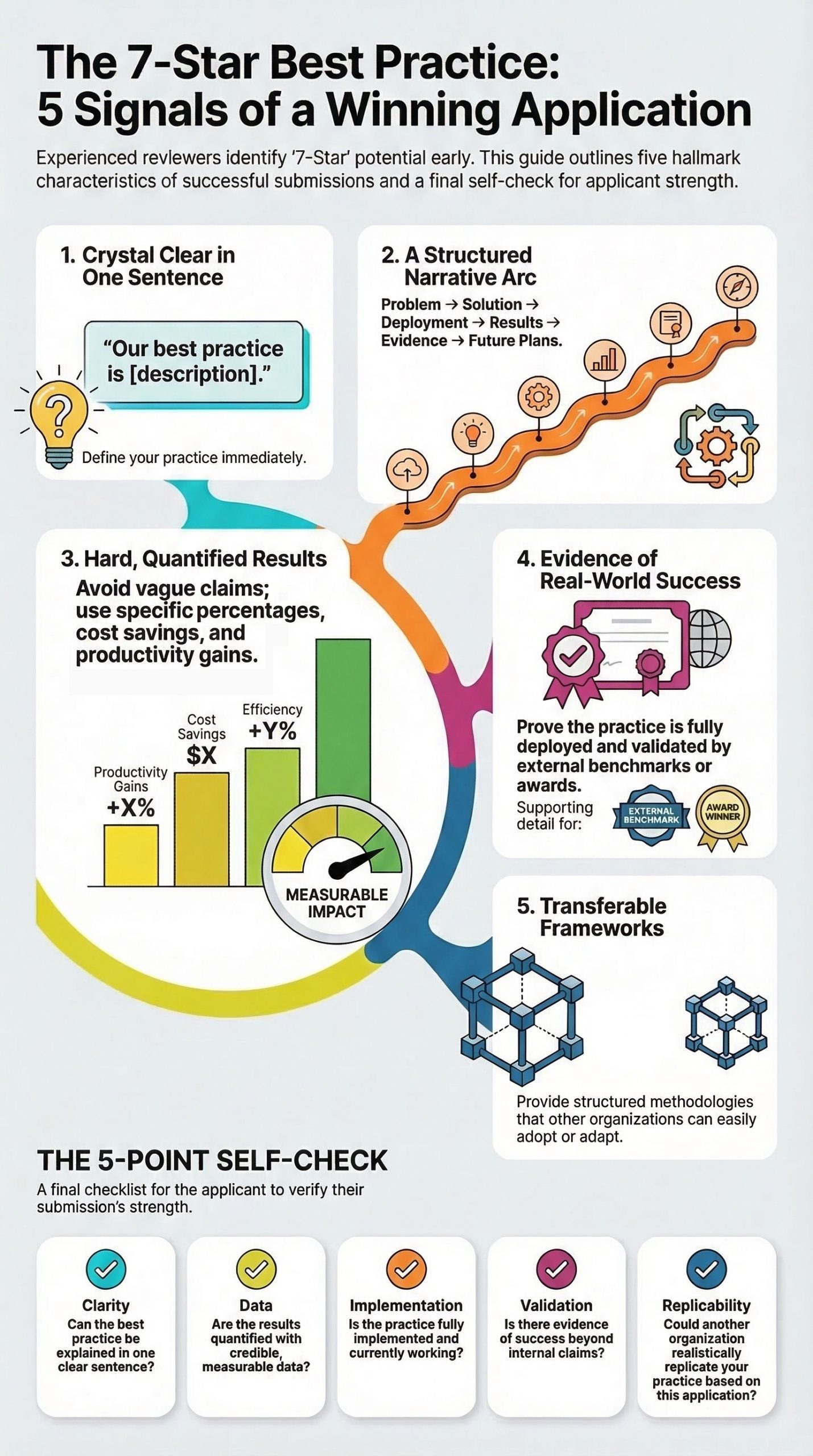
If you are preparing an application for the International Best Practice Competition, understanding these signals can help you present your work more clearly and effectively. Below are five characteristics that consistently appear in the strongest submissions.
 | 1. The Best Practice Is Crystal Clear in One Sentence |
The strongest applications make it immediately obvious what the best practice actually is.
A useful structure is to clearly state it early in the description using a simple format such as:
“Our best practice is…”
For example:
Our best practice is a ‘Circular Supply Loop’ system where 95% of all manufacturing waste is diverted from landfills by repurposing byproduct materials into standardized components for our entry-level product line.
This helps the reviewer quickly understand the core idea behind the initiative.
Weaker applications often take several pages before the reader fully understands what the practice is, or they describe multiple activities without clearly defining the main practice.
Tip: If someone can understand your best practice in the first paragraph, you are already on the right track.
 | 2. The Application Tells a Clear Story |
The strongest applications feel like a well-structured story. They follow a logical flow that guides the reader through the journey of the practice.
A typical structure looks like this:
- The problem or challenge is clearly explained.
- The best practice is introduced as the solution.
- Deployment describes how it was implemented.
- Results show the measurable impact.
- Evidence validates the credibility of the results.
- Future plans demonstrate sustainability and ongoing improvement.
When this flow is clear, the reader can easily follow the narrative and understand how the practice evolved and why it matters.
In contrast, weaker applications often feel fragmented or repetitive, making it harder for reviewers to connect the different sections.
 | 3. Results Are Quantified and Sustained |
Strong applications do not just present good results—they present clear, credible performance improvement over time.
This means three things:
✔ Quantified results
The application includes measurable data such as:
- Percentage improvements
- Cost savings
- Time reductions
- Output increases
✔ Before-and-after comparison
The reader can clearly see the change in performance, for example:
- Backlog reduced from 140 cases to zero
- Operating room utilisation increased from 65% to 85%
✔ Trend over time (sustainability)
The strongest applications go one step further and show that results are not a one-off success but are sustained over time.
For example:
- Monthly or quarterly performance trends
- Graphs showing consistent improvement
- Stable performance after implementation
This gives confidence that the practice is:
- working reliably, and
- embedded into operations
In contrast, weaker applications:
- provide only a single data point
- show improvement without a baseline
- do not demonstrate whether results are sustained
Tip: The best applications make it easy for the reader to see what changed, by how much, and for how long.
 | 4. Strong Best Practice Evidence |
A key difference between good and outstanding applications is the quality of the best practice evidence. Stronger applications clearly demonstrate that the practice is recognised, credible, and potentially world-class.
Strong applications include evidence such as:
- External benchmarking (how performance compares with other organisations)
- Awards or formal recognition
- Accreditations or certifications
- External audits or independent validation
- • Peer recognition, such as presenting the best practice at conferences or seminars that other organisations are learning from or adopting the practice
This type of evidence shows that the practice is not only effective internally, but also:
- validated externally
- credible beyond the organisation
- potentially a leading or best-in-class approach
Weaker applications often rely only on:
- internal performance data
- internal opinions or testimonials
While these are important, they are usually not sufficient on their own to demonstrate best practice at a higher level.
Tip: Ask yourself: What proof do we have that this is not just good internally, but also strong compared to others?
 | 5. The Practice Is Transferable |
Finally, strong applications describe practices that others could learn from.
A reviewer should be able to read the application and think:
“This is something other organisations could adopt or adapt.”
The best practices typically include:
- A structured framework or methodology
- Clear steps or stages
- Defined roles or processes
- Lessons learned and guidance for implementation
This makes the practice useful beyond the original organisation and increases its value as a recognised best practice.
 | A Simple Self-Check for Applicants |
Before submitting your application, you can quickly test its strength by asking yourself five questions:
- Can the best practice be explained in one clear sentence?
- Are the results quantified with credible data?
- Is the practice fully implemented and working?
- Is there evidence beyond internal claims?
- Could another organisation replicate the practice?
If the answer to most of these questions is “yes,” your application is likely on the right path.
 | Final Thoughts |
Great best practice applications are not only about great initiatives—they are also about clear communication.
By presenting your practice with a clear definition, a logical narrative, measurable results, credible evidence, and transferable insights, you make it easier for reviewers to understand the value of your work.
Ultimately, the goal is not just to describe what you did, but to clearly demonstrate why it matters and how others can learn from it.
Receive Our Newsletter
Keep informed on best practice research and business improvement events from around the globe - be the first to read our Best Practice Reports
| Share | LinkedIn Facebook Twitter |
| Posted by: | BPIR.com |
| Author: | BPIR.com |
| Source : | - |
| BPIR Category : | 14.2.1 Develop benchmarking capabilities 14.3 Improve organisational performance |
| Latest News Categories: | Best practices, Latest News, Must Attend Events |