

Like the world around us, an organisation shouldn’t be viewed as linear, mechanical, or predictable. Instead, it’s better understood as a complex adaptive system made up of interconnected and dynamic components that must work in harmony to succeed.
To foster this adaptability, organisations look for ways to be more innovative and profitable and to achieve capabilities they don’t currently have. Many organisations strive for business transformation to achieve this. However, a key factor in achieving successful transformation is the organisation’s ability to adapt its business model to evolving demands while staying aligned with its strategic direction.
Why Re-Evaluating the Business Model is Crucial
A business model outlines how an organisation creates, delivers, and captures value. It defines core aspects such as value propositions, target customers, revenue streams, cost structure, key resources, and partnerships. In today’s dynamic business environment, organisations must continuously re-evaluate their business models to remain relevant and competitive.
This article explores why re-evaluating a business model is crucial for the success of any business transformation. It highlights two real-world examples — BMW and Netflix — that showcase how leading organisations continuously adjust their business models to remain competitive. Finally, the article demonstrates how Business Excellence (BE) models provide a structured framework for organisations to consistently evaluate and refine their business models, ensuring they remain relevant in ever-changing markets.
Understanding the Existing Business Model: The First Step in an Organisational Transformation Journey
Putting it simple, the business model outlines ‘how an organisation plans to make money’. More specifically, the business model outlines how an organisation creates, delivers, and captures value. It defines the core aspects of a business, including its value proposition, target segments and customers, revenue streams, cost structure, key resources, and partnerships.
In today’s dynamic business landscape, organisations must continuously re-evaluate their business models to remain competitive in their markets. Below are a few recent examples of leading organisations that have successfully adapted their business models to keep pace with technological advancements and shifting customer preferences.
Success Stories: Organisations Adjusting Business Models While Maintaining Momentum
Tackling digitalisation — BMW’s initiatives and transformation
BMW is over 100 years old. It wouldn’t be here today if it hadn’t demonstrated a powerful strategic instinct and a robust and adaptive business model. Responding to the recent megatrend, the company decided to move decisively in driving its digital transformation strategy to improve its operations and digitise its products. BMW Group took the first steps on its journey to electromobility by launching project i in 2007. In addition to improving performance, comfort, and safety, BMW had to adjust processes globally to design, build, and supply more electrified vehicles. In 2017, BMW Group delivered 100,000 electrified vehicles to customers worldwide. In 2023, BMW handed over 330,596 electric BMWs to customers.
Netflix — Constantly adjusting its business model to remain competitive
Netflix was founded in 1997. Early in Netflix’s history, the company was focused on distributing physical DVDs to people via mail. At that time, Netflix’s business model was directly competing with brick-and-mortar movie rental stores. In 2007, Netflix started reaming service after YouTube proved that streaming video was technologically ready. With this change, DVD rental has become its side business. In 2013, Netflix moved ahead by creating and launching its own content, first with Lilyhammer in 2011 and then with the hugely successful House of Cards. Netflix continuously pivots its business model to stay successful.
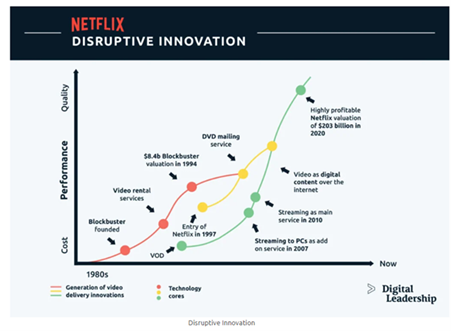
In 2023, Netflix’s total revenue amounted to approximately 33.7 billion U.S. dollars, which had grown from 3.4 billion U.S. dollars a decade ago. The American media company’s net income in 2023 stood at 5.41 billion U.S. dollars, with a total of 13,000 employees working at the company worldwide.
It is evident from the above examples that these organisations continuously adjusted their business models to respond to emerging technologies and changing customer preferences. They demonstrated dynamic business models and adaptive organisational thinking to meet the evolving needs of their customers and markets.
How Business Excellence (BE) Models Support Business Model Evaluation and Transformation
The examples of BMW and Netflix illustrate how successful organisations continuously adapt their business models to stay competitive. This is where BE models, such as the European Foundation for Quality Management (EFQM) Model and the Baldrige Performance Excellence Framework (BPEF), come into play. These models provide a structured approach that helps organisations understand, assess, and improve their business models. These models enable organisations to ensure their business model — the way they create, deliver, and capture value — remains aligned with evolving market demands and strategic goals.
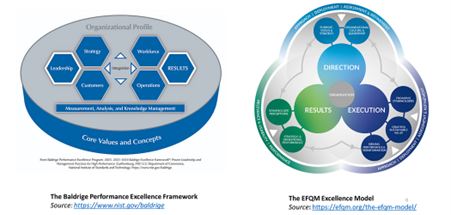
BE models are comprised of three key components:
1. Core Values & Concepts: These underpin the business excellence criteria requirements. For example, the BPEF includes core values like the Systems Perspective, which promotes viewing the organisation as a unified whole to achieve its mission and long-term success. BPEF’s core values and concepts are available here.
2. Excellence Criteria Requirements: Business excellence criteria requirements are key to effective business excellence assessments
3. Scoring System: The scoring of responses to criteria items are based on evaluation dimensions and factors
Both the EFQM and BPEF embed a systems perspective in their structure. For example, BPEF’s Systems Perspective encourages organisations to operate cohesively to achieve ongoing success and performance excellence. Similarly, The EFQM Model structure is based on the simple but powerful logic of asking three questions:
Why does the organisation exist? What is its purpose, and why has it chosen this strategy? (Direction)
How will the organisation deliver on its purpose and strategy? (Execution)
What has it achieved so far, and what are its future goals? (Results)
Embedding Continuous Improvement Through BE Models
A core strength of BE models is their focus on embedding continuous improvement within the organisation. BE models encourage organisations to continually evaluate and improve the key components of their business models to ensure sustained excellence and market responsiveness. This ongoing review ensures that business models remain flexible and responsive to technological changes, customer preferences, and competitive landscapes, making transformation more successful and sustainable.
Assessments play a central role in BE philosophy. BE models allow organisations to reflect on their performance and existing business models. These assessments can be internal (self-assessment) or external (conducted by external consultants). Both approaches provide detailed feedback, helping organisations identify opportunities for improvement. These assessments offer insights into areas where the business model may need adjustment to remain competitive.
The EFQM Model helps us ensure consistent alignment, realisation and outcomes (why, how and what) and permeates the entire organisation. Regular self and third-party assessments allow potential for improvements to be identified. Dr. Robert Engelhorn — CEO, Production, BMW North America
Business model adaptability is crucial in today’s fast-paced business landscape. Organisations like BMW and Netflix demonstrate that continuous evaluation and refinement of business models are key to long-term success. By providing a structured framework for assessing and improving business models, BE models empower organisations to remain agile and competitive in ever-changing markets. Adopting these models could help businesses stay ahead of the curve, ready to respond to new challenges and opportunities.
Thanks for reading! Reflect on these insights and consider how they apply within your organisational settings. If you found this article helpful, don’t forget to clap, share, and follow for more insights on driving business transformation through excellence.
Feel free to share your thoughts and engage with me on LinkedIn — I’d love to hear how you’re navigating change in your organisation!
Receive Our Newsletter
Keep informed on best practice research and business improvement events from around the globe - be the first to read our Best Practice Reports
| Share | LinkedIn Facebook Twitter |
| Posted by: | BPIR.com |
| Author: | Atif Baig |
| Source : | - |
| BPIR Category : | 14.3.2 Implement an improvement approach/method/technique 14.3.4 Conduct a business excellence assessment. 2.5.3 Develop and deploy action plans & projects |
| Latest News Categories: | Business Excellence, Latest News |