
Empowering Business Leaders and Policy Makers to Drive Systemic Competitiveness
The Unseen Mirror
Organizations often celebrate milestones like new product launches, increased sales, or expanded facilities. However, a critical question remains unasked: How do we compare with the best in our industry? This oversight isn’t due to hidden data but rather a lack of inquiry. While many organizations diligently track internal KPIs, such as on-time delivery, rejection rates, and service speed; these metrics often exist in isolation. A 90% customer satisfaction score might seem impressive until compared with a competitor’s consistent 97%. Completing a project on time may still be inefficient if others achieve the same with half the resources. Benchmarking unveils this hidden gap between ‘good enough’ and ‘world-class.’ It’s not a management or technological flaw but a perspective one. Without a comparative lens, strategies and policies risk being directionless.
This disconnect is not limited to manufacturing. In service sectors, such as schools, universities, hospitals, and government agencies, performance data may be collected but rarely benchmarked externally. A hospital may track its readmission rate without knowing how it compares to national or global standards. A university may celebrate graduation rates without assessing how well students perform on standardized outcomes relative to peer institutions. In public offices, citizen satisfaction scores or processing times are rarely benchmarked against leading municipalities. Without this external lens, even well-run institutions risk becoming ignorant and miss opportunities for systemic excellence.
Did You Know?
- A 90% customer satisfaction score may look great—until you learn your competitor averages 97%.
- Finishing a project on time is only impressive if you’re not using double the resources of others.
- Benchmarking helps uncover the gap between “good enough” and “world-class.”
Understanding Benchmarking and Best Practices
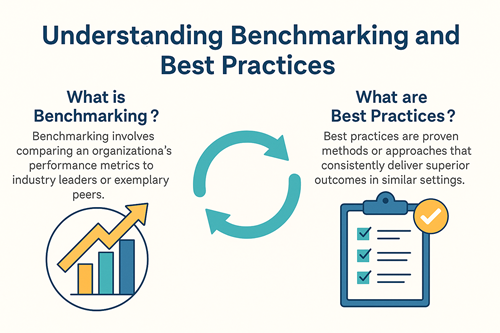
Benchmarking involves comparing an organization’s performance metrics to industry leaders or exemplary peers. It identifies internal inefficiencies and highlights external standards worth striving for. Essentially, benchmarking answers: Where do we stand, and how far are we from the best? Best practices are proven methods or approaches that consistently deliver superior outcomes in similar settings. They provide the actionable ‘how’, the tangible steps organizations can adapt to bridge performance gaps.
Together, benchmarking and best practices form a powerful performance loop: benchmarking provides the diagnosis, and best practices offer the remedy. One reveals the distance; the other guides the journey.
Global Lessons: Benchmarking in Action
Benchmarking and best practices are pivotal tools for organizations aiming to enhance performance and achieve excellence. The following categorization highlights organizations that specialize in these areas:
1. Organizations Primarily Focused on Best Practices
Centre for Organisational Excellence Research (COER) – New Zealand: Developed the TRADE Best Practice Benchmarking methodology, and organizing a unique annual Global Best Practices Competition, guiding organizations through structured approaches to identify and implement best practices.
2. Organizations Primarily Focused on Benchmarking
American Productivity and Quality Center USA (APQC): Offers the Process Classification Framework (PCF) and the Open Standards Benchmarking database, providing access to over 1,200 performance measures across various business processes.
Singapore Productivity Centre (SGPC): Provides benchmarking services enabling companies to assess productivity performance against industry averages and best-in-class companies.
SME Corp Malaysia – SCORE: A diagnostic tool assigning star ratings to indicate SME performance levels based on criteria like financial strength and business performance.
3. Organizations Integrating Both Benchmarking and Best Practices
Korea Productivity Center (KPC): Conducts comprehensive productivity analyses at national, industrial, and corporate levels, identifying leading entities and disseminating best practices to foster a culture of excellence.
The Regional Gap: A Call to Action
Despite the clear benefits, many developing countries, including Pakistan, have yet to institutionalize benchmarking as a strategic tool. Organizations often operate without access to comparative data, standardized frameworks, or even the necessary terminology for meaningful analysis. When benchmarking is attempted, it frequently manifests as a one-off study or a consultant’s report, lacking continuity and leadership backing. This fragmented approach fails to embed benchmarking into the organizational culture, resulting in missed opportunities for sustained improvement. Imagine a national portal where industries like textiles could anonymously compare key performance indicators (KPIs) such as cost per unit, first-time-right production, and energy consumption. Hospitals could benchmark infection rates and treatment efficiency. Such data could inform policy decisions, guide consultants, and help CEOs set realistic targets. The establishment of such benchmarking platforms has proven effective elsewhere. For instance, Australia’s National Benchmarking Portal provides healthcare providers with access to data on cost per National Weighted Activity Unit (NWAU), hospital-acquired complications, and avoidable hospital readmissions, facilitating informed policy decisions and improved patient outcomes. By adopting similar initiatives, Pakistan and other developing countries can foster a culture of continuous improvement, enhance competitiveness, and drive sector-wide performance upgrades.
Why Leaders Should Prioritize Benchmarking
For corporate leaders and policymakers, benchmarking transcends mere technical metrics; it serves as a strategic compass for informed decision-making. It addresses pivotal questions: Should we expand this facility or enhance its efficiency? Is it more beneficial to fund this SME cluster or provide targeted coaching? Does this department’s performance warrant celebration, or do delays necessitate investigation?
Benchmarking provides the clarity needed to navigate these decisions by offering visibility into performance standards and practices. This visibility fosters accountability, encouraging organizations to strive for excellence. However, embracing benchmarking requires a commitment to transparency and continuous improvement. Leaders must cultivate a culture that values data-driven insights, invest in training teams on best practice methodologies, and encourage learning from both successes and shortcomings. By institutionalizing benchmarking, organizations can not only identify areas for enhancement but also replicate successful strategies, leading to sustained growth and competitiveness.
Sector-Specific Insights and KPIs
To make benchmarking more actionable, organizations should focus on sector-specific Key Performance Indicators (KPIs). Tailoring KPIs to the unique aspects of each sector enables more precise performance assessments and targeted improvements. Some example KPIs could for competitiveness could be:
Sector-Specific KPIs for Benchmarking
Tailored KPIs enable organizations to make precise performance assessments and targeted improvements across different industries.
Sector | Key Performance Indicators (KPIs) |
|---|---|
| Manufacturing | Defect Rates, OEE, Cycle Time, Rework Rate, Right First Time %, Delays % |
| Healthcare | Patient Satisfaction Scores, Infection %, Readmission Rates, Avg Length of Stay |
| Government Services | Service Delivery Times, Citizen Satisfaction Index, Budget Adherence Rates |
| Research & Development | Time to Market, Patents Filed, R&D Expenditure as % of Sales |
| Finance | Return on Investment (ROI), Cost-to-Income Ratio, Budget Variance |
| Maintenance | MTBF, Maintenance Cost per Unit, Downtime %, Machine Failure Rate, Idle Time |
| Supply Chain | Order Fulfillment Cycle Time, Inventory Turnover, Supplier Defect Rates |
Making Benchmarking Work — From Insight to Action
Benchmarking isn’t a boardroom luxury, it’s an operational habit rooted in curiosity and intent. In companies that do it well, it usually starts with a leadership conversation: Where are we underperforming, and who’s doing it better? From there, a cross-functional benchmarking team is formed, typically led by the Quality or Strategy Department, not board members directly. Their job is to identify key KPIs, gather reliable data, and explore both benchmarking and best practices across industries. While arranging benchmarking visits is often difficult—especially with competitors who may hesitate to share internal processes—valuable lessons can still be gained through cross-industry learning and best practice sharing. For example, a bank might study how a courier company manages its dispatch systems to enhance its own operations, or a hospital might adopt best practices in document control from a software company. Similarly, a university could learn about customer journey mapping from the retail sector to improve student experience. These practical insights, when documented and contextualized, become powerful enablers of performance improvement. The true value emerges when benchmarking results and best practice examples are converted into structured initiatives, linked to strategic goals and actively monitored. The board’s role is not to manage this process, but to demand it, support it, and use its outputs to guide organizational direction. Done right, benchmarking and best practices are not about imitation—they are about intelligent adaptation and continuous learning.
From Awareness to Institutional Action
Benchmarking is not just a method, it is a mindset. A mindset that replaces assumptions with facts, silos with shared learning, and complacency with data-driven urgency. Its absence doesn’t merely represent a missed opportunity; it often means mediocrity is allowed to scale unchecked. Across manufacturing plants, universities, hospitals, and ministries, a striking pattern emerges the moment organizations truly see where they stand. Whether it’s discovering that their defect rate is five times higher than the industry average, or their process lead time double the global norm, that single point of awareness often becomes a turning point. It shifts the conversation, from internal comfort to external relevance. From effort to outcomes. For corporate leaders, benchmarking is a tool to lead smarter, faster, and more strategically. For policymakers, it is a compass to guide national priorities, focus investments, and elevate sector-wide performance. But unlocking its value is not accidental. It demands robust infrastructure, legal frameworks that safeguard data confidentiality, digital benchmarking platforms, and active industry cooperation. Most importantly, it requires leadership that embraces transparency and continuous improvement, not as slogans, but as operational priorities.
A Final Challenge to Leaders
The benchmarking gap is real, but it is not irreversible. The true challenge lies not in understanding its importance, but in building the commitment and systems to sustain it. The question isn’t whether benchmarking works; it’s whether we are willing to make it work. It’s time to stop asking, “How are we doing?” in isolation. It’s time to start asking, “How are we doing compared to the best—and how far can we go?”
“Benchmarking isn’t about imitation, it’s about illumination. It reveals not just where you stand, but how far you can go.”
About the Auther:
 | Dr. Kamran Moosa, Chief Executive, PIQC Institute of Quality, Pakistan Chief Executive of PIQC Institute of Quality (Pakistan), Experienced Researcher & Professor, International Trainer & Consultant, Author and Advisor to National Institutions in the field of Quality Engineering & Management. He is a Member of International Academy for Quality (IAQ). He Chairs Quality in Education Think Tank (QiETT) of IAQ. He is the recipient of the Ishikawa-Kano Silver Medal award by Asian Network for Quality (ANQ) from among three other awardees from Asia in 2020. He has also been awarded Regional Productivity Award by the Asian Productivity Organization (APO-Japan) in 2021. He is an author of five books on Quality and Lead Instructor of Lean Six Sigma Green/Black Belts. |
Receive Our Newsletter
Keep informed on best practice research and business improvement events from around the globe - be the first to read our Best Practice Reports
| Share | LinkedIn Facebook Twitter |
| Posted by: | BPIR.com |
| Author: | Dr. Kamran Moosa |
| Source : | - |
| BPIR Category : | 14.2.1 Develop benchmarking capabilities |
| Latest News Categories: | Benchmarking, Best practices, Latest News |