
Business Excellence frameworks represent the systematic and integrated approach of continuous improvement that enables an organisation to address change and ensure sustainable growth. While these frameworks are often perceived as complex for small organisations, MESA Products Inc. — a three-time Baldrige Award winner — demonstrates how even a small business can leverage business excellence principles to achieve exceptional performance. This article explores MESA’s journey and shares key strategies and insights that can help and inspire other organisations to thrive in today’s competitive business world.
Small and Medium Enterprises (SMEs) play a crucial role in driving economic growth and prosperity in a country. In many OECD nations, SMEs are estimated to account for as much as 70% of the national GDP. However, SMEs face distinct challenges in managing sustainable growth and performance. Research from the World Economic Forum and the National University of Singapore Business School indicates that 67% of SME executives cite survival and expansion as their main challenges.
Business excellence frameworks, such as the Baldrige Excellence Framework and the EFQM model, are proven performance improvement tools that thousands of organisations use. These frameworks provide a structured approach for organisations to understand, assess, and improve their business models.
Many SME organisations are hesitant to pursue business excellence, often due to limited resources and expertise in business excellence. Despite these challenges, some small organisations make bold strategic decisions and choose to adopt business excellence practices. One such example is MESA Products Inc. By embracing the Baldrige Excellence Framework, MESA transformed its performance and became a leader in its industry. This case offers valuable lessons for other SMEs seeking to improve their business models and sustain growth.
The following sections explore MESA’s journey in detail, offering key insights that can help other organisations improve their business models for sustained growth. Before diving into MESA’s story, however, it is important to understand the Baldrige approach to organisational excellence. This approach forms the foundation for MESA’s transformation, and understanding it is critical to understanding how SMEs can achieve similar success.
Baldrige’s Approach to Organisational Excellence: Core Values and Performance Criteria:
The Baldrige program defines business/organisational excellence as an integrated approach to organisational performance management that results in:
(1) delivery of ever-improving value to customers and stakeholders, contributing to ongoing organisational success;
(2) improvement of the organisation’s overall effectiveness and capabilities; and;
(3) learning for the organisation and for people in the workforce.
The Baldrige excellence framework is based on 11 core values and concepts. The detailed criteria delineate the seven categories that emerge from these core values and concepts. These categories provide a systems approach that helps organisations achieve high performance.
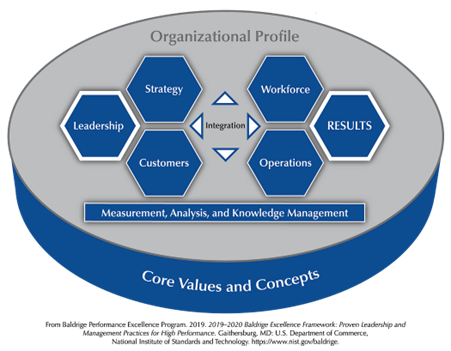
The following sections cover MESA’s excellence journey. The section concludes with a summary of MESA’s learnings and a takeaway for SMEs to consider adopting business excellence methodologies.
MESA’s Excellence Journey: From “Seat-of-the-Pants” to Strategic Leadership
From a one-person consulting firm founded in 1979, MESA has grown to support a workforce of more than 250 people. MESA is a leading corrosion control and integrity solutions provider. As per the latest results published on the NIST website:
• MESA’s new market growth has increased from $14 million in 2018 to $16 million in 2019. MESA’s cumulative growth relative to competitors has improved by 40% over five years, with growth outpacing five separate competitors.
• MESA’s overall revenue per employee has exceeded multiple benchmarks since 2016, improving from about $320,000 in 2014 to $370,000 in 2019, nearly $100,000 more than a competitive benchmark.
• MESA has retained 100% of key customers in its Services segment since 2018 and 97% of key customers in its Materials segment from 2017 to 2019.
• Matching the Great Places to Work 90th percentile benchmark, 95% of MESA’s employees agreed that the safety culture was a top organisational priority.
• Average customer satisfaction for services has trended at more than 4.5 out of 5 since 2017.
How It All Started
In 2002, Terry May, founder and CEO of MESA, recognised the need for a structured approach to achieving sustained growth. While sharing his first encounter with the Baldrige Excellence Framework, Terry mentioned, ‘We’d been on a continuous improvement journey for 10 years, but it wasn’t really a journey. It was a series of fixing things. When I first read the [Baldrige] Criteria, it was an almost immediate realisation that this was the package I had been looking for. We had the beginning of the individual pieces, but the Baldrige wrapped it up so neatly.’
MESA took five years in their first venture to get all senior leaders on board. As Terry referred to it as ‘passive resistance,’ this challenge impacted the first few years of MESA’s excellence journey. Ultimately. All leaders were on board for the journey. Real progress began once the entire leadership team united to implement excellence.
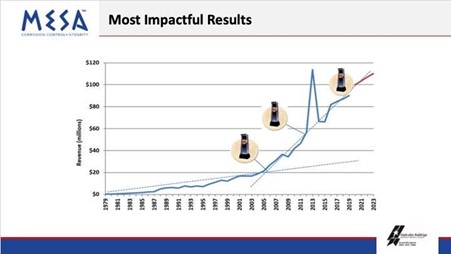
Since embarking on the Baldrige Excellence Framework, MESA has maintained an average growth rate of almost 10%. As Terry May mentioned in one of his interviews, “we were on a path of growth before we started practicing Baldrige, but that growth line shifted exponentially after we started.”.
The graph below exhibits the MESA story well.
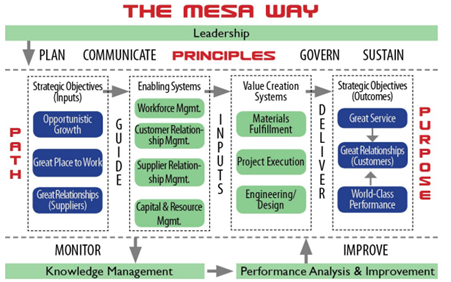
Visionary leadership and strategic foresight: The most important insight that emerged from the MESA story is the ability of its founder and first CEO, Terry May, to identify the weaknesses in MESA’s business model and the need for a robust management system at the time. Simultaneously, he recognised the potential in his people, products, and services. His informed decision to join the Baldrige program in 2002 paid off through improved financial performance, more engaged employees, and satisfied customers in the following years. According to their 2012 awards application, the MESA Business Model — ‘ The MESA Way’ — aligned and integrated resources and operations into a professional, highly effective team committed to achieving strategic objectives.
Continuously Striving to Become Better: MESA’s leadership embedded a culture of continuous improvement into the organisation’s DNA. From their first Baldrige award process, they took the award’s feedback reports and opportunities for improvement (OFIs) seriously and ensured that these insights drove actionable change within the organisation.
MESA strengthened its business model by consistently implementing OFIs and seeking external validation. It also became evident that MESA’s leadership was more focused on learning from the award process than on the recognition itself, which made the otherwise cumbersome award application process more rewarding for the team.
A ‘Family’ Workforce: Another strength of MESA’s success is its well-aligned and productive workforce. MESA employees frequently describe their colleagues and workplace environment as “family.” Employees share in financial success through a profit-sharing program. A great example that emerged from MESA was its response to the COVID-19 pandemic. MESA responded to COVID with a Pandemic Bonus, a Pandemic Pay Program, and a commitment to no layoffs. This further reinforced the family culture of MESA. As per MESA 2020 award application, 94% of employees considered themselves highly engaged, exceeding the TLF loyalty benchmark by 24%, and 90% considered themselves highly satisfied, surpassing the TLF satisfaction mean by 22%. (TLF is a customer research firm based in the United Kingdom).
A robust communication approach: It was found from MESA award reports that the MESA senior leadership employs different communication vehicles to reinforce high performance. The MESA communications plan is comprehensive and includes weekly e-mail messages to the organisation, town hall meetings, group meetings, and an open-door policy.
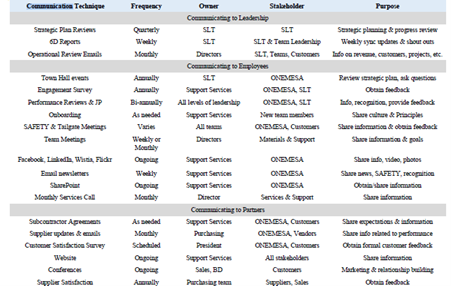
The effectiveness of various methods of communication is measured annually through the Employee Engagement Survey & VOC (Voice of Customer) feedback. MESA received an OFI in 2019 Baldrige feedback report to improve communication. In response to the OFI, more actions were added to the existing communication approach, such as all senior leaders and operational leaders to visit field projects at least quarterly, a monthly call with all field employees to communicate key results and initiative updates, regularly shipped care packages to crews, and more. Improvement projects designed to drive engagement are included in the 2020 strategic initiative to Improve Workforce Engagement, targeted primarily toward field employees.
Comprehensive Strategic Planning Process: MESA projects future performance from performance reviews and key comparative data. Measures and rolling targets for strategic objectives are cascaded down to managers when appropriate. Multiple sources of data are shared on electronic dashboards. This information is applied to inform the identification of organisational and operational unit initiatives. MESA uses its 6D (Six Disciplines of Excellence) framework to integrate and deploy its Purpose, Path, and Principles across the organisation. The 6D process is supported by software that has helped MESA become more aligned & systematic.
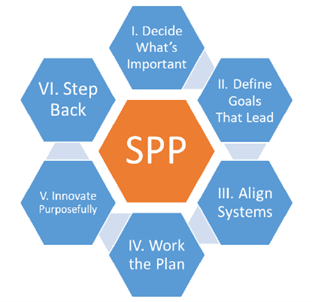
Annual, quarterly, and weekly 6D planning meetings are continually held to review organisational performance against goals. MESA utilises the findings from performance reviews and key comparative data in projections of the organisation’s future performance. Progress on these measures and targets is regularly reviewed, and operational or customer issues have driven new solutions and learning.
Bottom line
MESA’s journey demonstrates that even small organisations with the right leadership vision and commitment can achieve exceptional results. MESA’s transformation has shown that embracing business excellence frameworks can help organisations drive sustained growth. It is evident that MESA has embedded Baldrige’s core values and concepts into its daily operations, and therefore, each of its processes exhibits integrated excellence.
For SMEs seeking to thrive in today’s competitive environment, now is the time to assess their current business model and take the first steps toward transformation. Consider starting with a self-assessment or exploring industry-recognised frameworks like the Baldrige Excellence Framework or the EFQM to identify areas for improvement. Don’t wait for the perfect moment to begin your excellence journey—start small, but start today!
You can access and read more Baldrige Award applications here.
Thank you for reading. Feel free to share your thoughts and engage with me on LinkedIn (Atif Baig) or through my Medium page.
Receive Our Newsletter
Keep informed on best practice research and business improvement events from around the globe - be the first to read our Best Practice Reports
| Share | LinkedIn Facebook Twitter |
| Posted by: | BPIR.com |
| Author: | Atif Baig |
| Source : | - |
| BPIR Category : | 14.3.2 Implement an improvement approach/method/technique 14.3.4 Conduct a business excellence assessment. |
| Latest News Categories: | Business Excellence, Latest News |