
In the fast-paced business world, strategic myopia — the inability to see beyond immediate or distant goals — can have severe consequences. Leaders who focus too narrowly on short-term gains or distant goals risk missing critical shifts in customer needs, technological advancements, and competitive dynamics. This short-sightedness can gradually erode an organisation’s ability to adapt and remain relevant in a changing market.
This article explores strategic myopia through two real-world examples, revealing its pitfalls and demonstrating how structured management practices can help leaders balance short-term achievements with long-term resilience.
Managing organisational performance in today’s dynamic landscape is a complex task that demands a delicate balance between immediate results and long-term vision. Leaders who focus excessively on short-term gains—or, conversely, on distant goals—risk falling into strategic myopia, where critical shifts in customer needs, technological advancements, and competitive threats may be overlooked. This shortsightedness quietly undermines an organisation’s potential for sustained success, leaving it vulnerable to disruption.
Fortunately, strategic myopia can be overcome. Robust management models provide leaders the tools to balance short-term objectives with sustainable growth, fostering a forward-looking mindset that strengthens organisational resilience.
What is Strategic Myopia?
Strategic myopia is a narrow vision in business strategy that results from leaders focusing on immediate gains or distant goals and overlooking crucial changes in the marketplace. As a result of this shortsightedness, organisations can be unable to respond to changing customer preferences, emerging technologies, or competitive threats on time. Eventually, this gap between the organisation’s focus and the external environment reduces its ability to adapt, leaving it vulnerable to decline. Strategic myopia often occurs when organisations become overly focused on short-term achievements, causing them to lock into outdated strategies and miss opportunities as market demands shift. This can result in overlooking changes in customer preferences, technology, or competitive threats, eventually leading to performance decline.
Such short-sightedness impacts organisations both operationally and strategically. Operationally, products and services may become outdated, reducing their relevance in the market. Strategically, organisations may continue investing in areas where growth is increasingly challenging.
Strategic myopia, therefore, reflects a cognitive gap between an organisation’s established practices and the external environment’s dynamic realities. If left unaddressed, this gap restricts adaptability, compromising the organisation’s ability to achieve sustained success.
Real-World Examples of Strategic Myopia
Strategic myopia has tangible and costly consequences, as seen in some notable business failures. Here are case studies from Kodak and BlackBerry that illustrate the dangers of short-sighted thinking.
Kodak’s Missed Opportunities
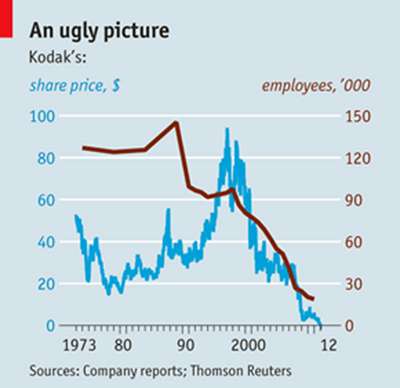
Kodak’s story highlights the risks of strategic myopia. Despite inventing digital photography in the 1970s, Kodak remained committed to its profitable film business, underestimating the shift towards digital. Although Kodak engineer Steve Sasson invented the first digital camera in 1975, Kodak’s management dismissed it as a novelty, viewing it as no real threat to their film business. By the early 1980s, market research suggested digital photography could replace film within a decade, but Kodak instead bolstered its film business. The board’s decision to appoint traditional leaders like Kay Whitmore further entrenched this approach, leading to costly missteps.
 The first digital camera from Kodak, weighed 3kg, was the size of a toaster, and produced a 0.01 megapixel image that took 23 seconds to record onto a digital cassette tape.
 Source: The last Kodak moment? (economist.com)
Throughout the 1990s and early 2000s, Kodak’s investments in hybrid products, such as the Advantix Preview — a blend of digital and film technology — failed to align with market trends. Diversification into unrelated areas, like acquiring Sterling Drug, drained resources without delivering strategic value. Ultimately, Kodak’s reluctance to shift from a “make-and-sell” to an “anticipate-and-lead” model left it vulnerable to the digital revolution it had helped pioneer.
BlackBerry’s Decline from Market Leader to Obscurity
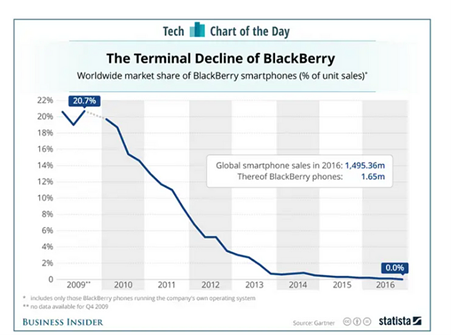
BlackBerry’s journey from market leader to a niche player illustrates the consequences of missed opportunities. Originally launched as Research in Motion (RIM) in 1984, BlackBerry dominated the U.S. smartphone market by the early 2000s with its secure, email-centric devices and iconic QWERTY keyboard. However, as competitors, notably Apple, introduced touchscreen devices that redefined the smartphone experience, BlackBerry’s attachment to its traditional keyboard design became a liability. Despite indicators of shifting consumer preferences, BlackBerry continued prioritising its existing design, which soon led to its decline.
 Blackberry Key2LE, the last Blackberry phone, released in 2018
 Source: Gartner
In 2008, BlackBerry released the Storm, its first touchscreen device, aiming to compete with the iPhone. However, the device was plagued with software issues and lacked Wi-Fi, disappointing consumers and eroding confidence in the brand. BlackBerry’s PlayBook tablet, launched without email functionality, further undercut its appeal to business users. Competitors like WhatsApp capitalised on cross-platform messaging, while BlackBerry restricted its popular BBM service to its own devices. By 2016, BlackBerry held less than 1% of the global smartphone market and eventually exited smartphone production altogether.
Why Does Strategic Myopia Occur?
Strategic myopia often sets in when leaders cling too tightly to established strategies, failing to recognise transformative innovations and shifting consumer demands. This narrow focus can stifle adaptability, leaving organisations vulnerable to agile competitors ready to capture emerging opportunities. Kodak, by holding onto traditional film, missed the digital transformation wave, while Sony embraced it and rose in the photography market. Such ‘blind spots’ can lead organisations to miss disruptive trends that seem distant initially but ultimately redefine industries.
How Business Excellence Models Combat Strategic Myopia
Business Excellence (BE) models, such as the EFQM and the Baldrige Performance Excellence Framework offer structured management practices that help organisations overcome strategic myopia. These models guide leaders in balancing short-term gains with long-term growth by emphasising innovation, customer focus, and operational effectiveness. By regularly assessing business strategies, BE models help organisations identify and address potential (strategic) blind spots early, promoting resilience and adaptability.
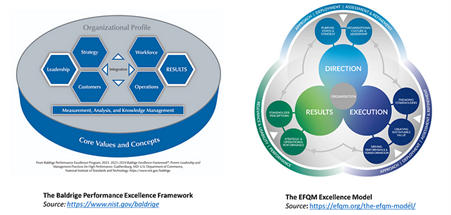
The EFQM and Baldrige models encourage organisations to go beyond immediate gains, focusing on long-term value creation and adaptability. Through criteria such as leadership, customer focus, and operational effectiveness, these models help organisations evaluate areas that may be neglected when overly focused on short-term gains. The scoring systems within each model provide objective performance measurement, helping organisations identify strengths and improvement areas. By embedding these structured approaches, organisations gain a balanced perspective that enhances adaptability and resilience.
Conclusion and Recommendations
In today’s fast-paced world, organisations are at significant risk of strategic myopia. Examples like Kodak and BlackBerry illustrate the danger of focusing on past achievements or immediate gains while resisting market changes. Organisations can build a foundation for sustained growth by embracing business excellence practices.
Practitioner Insights:
For leaders looking to overcome strategic myopia, here are some actionable insights grounded in Business Excellence principles:
• Stay Vigilant to Market Shifts: Regularly monitor changes in customer needs, technology, and competitor activities. Business Excellence practices encourage continual internal/external scanning, helping you stay aligned with market realities.
• Balance Immediate Gains with Long-Term Goals: Use management models like EFQM and Baldrige to guide your organisation toward sustainable growth. These models provide structured approaches to balance the need for short-term performance with long-term resilience.
• Foster an Agile Mindset: Cultivate a culture that values adaptability. Encourage teams to embrace change and respond quickly to emerging opportunities or challenges.
• Invest in Continuous Improvement: Make it a priority to reassess and adjust strategies regularly. Small adjustments made proactively can prevent larger course corrections later, maintaining your organisation’s relevance in a dynamic environment.
Thanks for reading. Please reflect on these insights and consider how they apply within your organisational settings. Feel free to share your thoughts and engage me on Atif Baig | LinkedIn and Medium.
Receive Our Newsletter
Keep informed on best practice research and business improvement events from around the globe - be the first to read our Best Practice Reports
| Share | LinkedIn Facebook Twitter |
| Posted by: | BPIR.com |
| Author: | Atif Baig |
| Source : | - |
| BPIR Category : | 14.3.3 Implement an org-wide continuous improvemnt program 14.3.4 Conduct a business excellence assessment. |
| Latest News Categories: | Business Excellence, Latest News |